Science & Evidence
Principles first.
Evidence published
as it is produced.
Evolv is designed around established ideas in movement, coordination and motor learning. This page separates what the field has established, what research has observed, and how we intend to test the system.
01 — Established principles
What the field has established
These are widely accepted concepts in human performance and motor control. They describe the terrain Evolv is designed for — they are not evidence about the Evolv System itself.
P-01
Motor control
Movement is organised by the nervous system, not by muscle alone. The same joint action can be produced by different coordination strategies, and those strategies are trainable.
P-02
Specificity of adaptation
The body adapts to the demand it is given. The task, the position and the constraint applied all shape what improves.
P-03
Motor learning
Skill acquisition is driven by practice with meaningful variability and feedback. Repetition alone is not the mechanism.
P-04
Stability and control
Producing force is only part of performance. Controlling position and resisting unwanted motion determines how much of that force is usable.
P-05
Constraint-led practice
Changing the conditions of a task changes how the athlete solves it. Constraints are a recognised way to shape movement without instruction.
P-06
Movement efficiency
Efficient movers achieve the same outcome with less wasted motion. Efficiency is a quality of organisation, and organisation can be trained.
02 — Evolv approach
How the system is designed around them
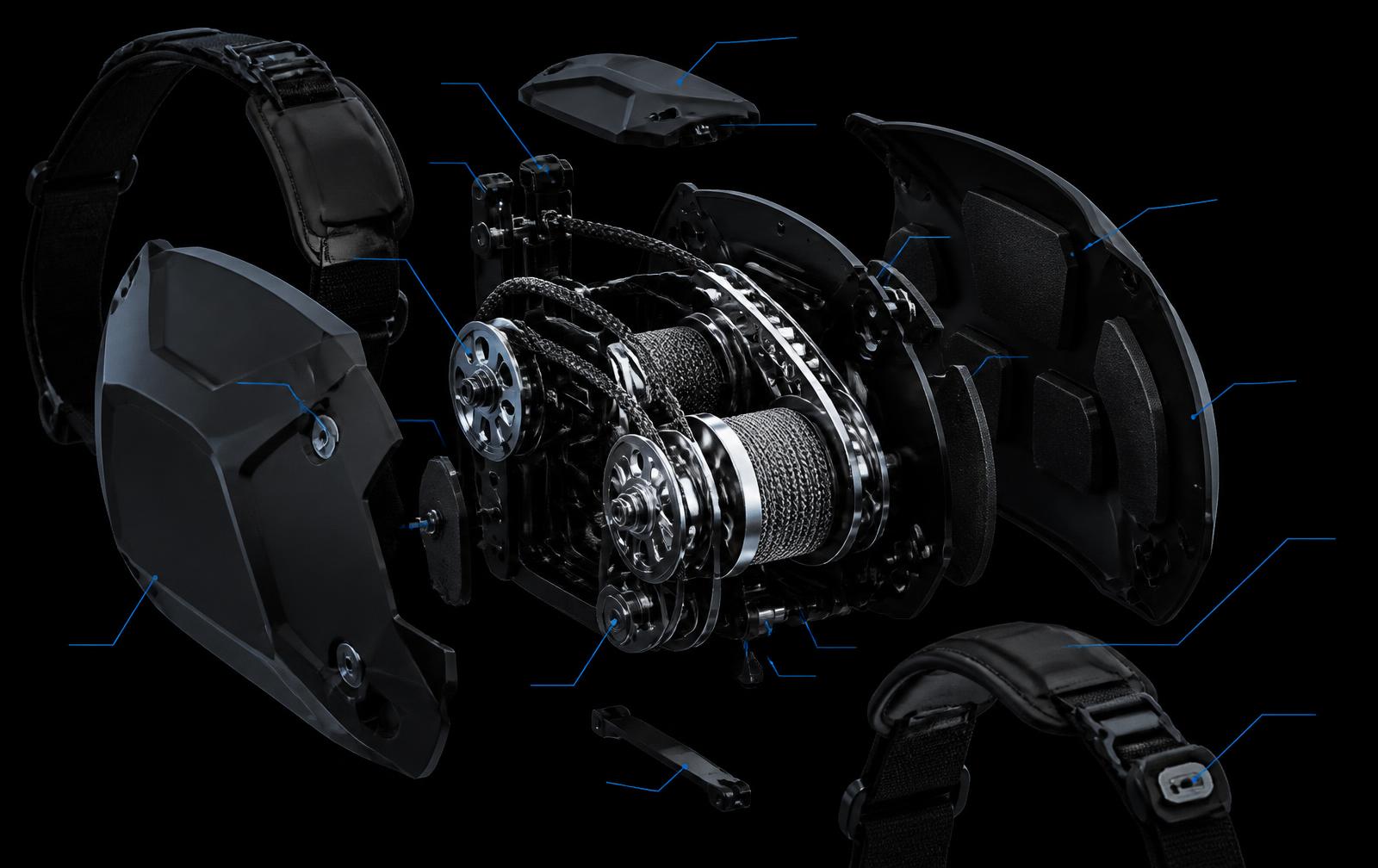
Every design decision traces back to a principle above. This is design rationale — it describes intent, not measured effect.
Load inside natural movement
Rather than isolating a joint, the system applies tension while the athlete performs the movement they already train — a constraint applied to the whole pattern.
Multi-point resistance
Cables at the wrists and knees mean the demand is distributed, so coordinating between upper and lower body becomes part of the task.
Continuous tension through range
Tension is present through the movement rather than only at a sticking point, keeping the control demand active throughout.
Load that travels
Because the mechanism is worn, the athlete can move through space — practice can stay closer to the sport context.
03 — Research findings
Why Evolv helps every athlete.
Research conducted with the NeuroPak system at Purdue University, UTSA, and through DARI Motion analysis identified improvements across several foundational dimensions of movement. These dimensions are not sport-specific. They are the underlying qualities athletes rely on whenever they sprint, jump, swing, throw, cut, hit, or defend.
01
Center of mass control
Improved control of the body's center of mass can help athletes stay balanced, stable, and ready to produce force through dynamic movement.
02
Kinematic sequencing
More coordinated sequencing between the hips, trunk, and limbs supports efficient transfer of force through the kinetic chain.
03
Inter-limb coordination
Better coordination between the left and right sides of the body supports smoother, more synchronized movement.
04
Motor learning
The research investigated whether wearable resistance and proprioceptive feedback can support faster acquisition and retention of movement patterns.
05
Symmetry & stability
The research identified improvements in measures associated with asymmetry, stability, balance, and control, including measures involving knee alignment, ankle behavior, and trunk movement.
06
Proximal muscle activation
Research involving muscle activation examined changes in recruitment across the hips, glutes, trunk/core, and other muscles involved in stabilizing and transferring force.
Foundations
These are the foundations of performance.
Whether an athlete sprints, jumps, swings, throws, hits, cuts, or defends, the body still has to coordinate the same fundamental systems: stability, sequencing, balance, symmetry, proprioception, and force transfer. Evolv is designed to train those foundations within the athlete's normal movement.
Strength alone does not automatically create better performance.
Build the movement. Then build the strength.
The research points toward a simple training idea: athletes benefit when foundational movement qualities improve before, or alongside, increases in load and intensity.
Training advantage
The Evolv training advantage.
Evolv is designed to integrate into the training an athlete is already doing. Rather than requiring a separate drill or replacing sport-specific work, the system adds an additional movement challenge while the athlete performs familiar movements.
Without requiring a separate training session or changing the athlete's existing drills.
Research highlights
Verified numbers will follow.
The underlying research reports and source documentation are being reviewed. Once verified, the strongest quantitative findings from each research program will be published here with the method, sample, and measurement attached.
R-01
Purdue University
Motor Learning & Movement Research
—
Quantified findings pending
R-02
UTSA
Biomechanical / Kinematic Analysis
—
Quantified findings pending
R-03
DARI Motion
3D Movement Analysis
—
Quantified findings pending
04 — Evolv evidence
Our data, as it is produced
This is where Evolv-specific testing is published. Each record below will carry its method, its sample, its measurement and its result — including results that do not support our expectations. Until a record is complete, it stays empty.
Record
Scope
Status
E-01
Product testing
Bench and durability testing of the resistance mechanism, cables and hardware.
In progress — no data published
E-02
Tension characterisation
Measured tension profile across cable travel.
In progress — no data published
E-03
Movement measurement
Instrumented movement data collected with and without the system.
In progress — no data published
E-04
Field testing
Structured testing with coaches and training groups.
In progress — no data published
E-05
Independent review
Third-party evaluation of methods and results.
In progress — no data published
No Evolv performance results, statistics or study findings are published on this site yet. When they are, they will appear here with the method attached.
05 — Validation roadmap
How we intend to test the system
A sequence, not a promise of results. Each phase has to be completed before the next one means anything.
Phase 01
Engineering validation
Characterise the hardware: tension consistency, cable travel, durability under repeated load.
Phase 02
Measurement protocol
Define what we measure, how, and what would count as a meaningful change.
Phase 03
Applied field testing
Work with performance professionals under a defined protocol and document outcomes as collected.
Phase 04
External collaboration
Invite independent researchers to test the system and publish their findings.
Working on movement research?
We are looking for performance professionals and researchers to test the system under a defined protocol. See the system in action and discover how Evolv can fit into your training.